A practical guide to the deductions individuals can access before the end of the 2026 financial year
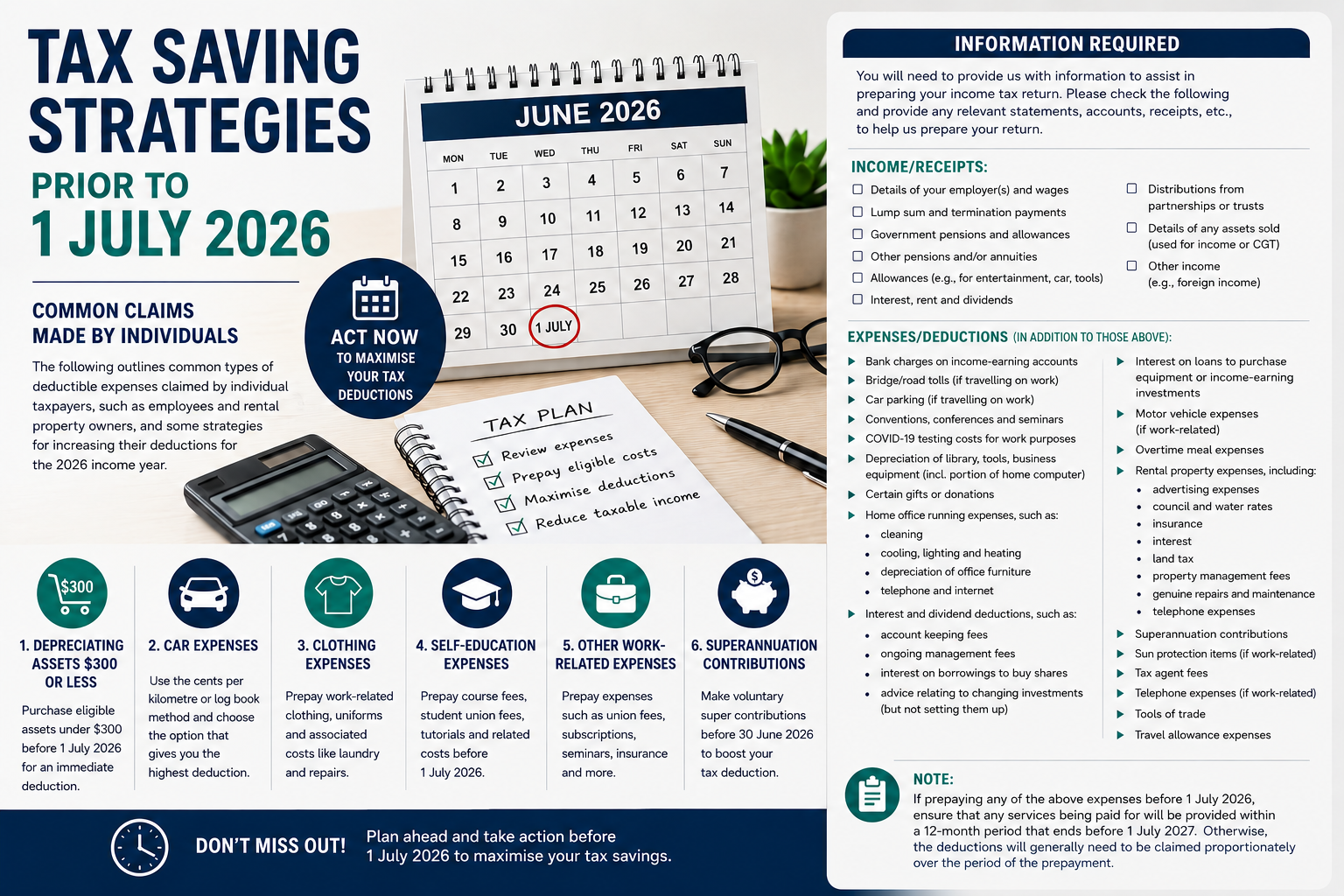
As the end of the financial year approaches, it is an ideal time to review your finances and consider strategies that may help maximise your tax deductions for the 2026 income year. Below are some of the most common deductible expenses and practical steps individuals can take before 1 July 2026.
Common Deduction Opportunities
1. Depreciating Assets Under $300
Employees and rental property owners may be eligible for an immediate deduction on income-producing assets costing $300 or less, provided they are purchased before 1 July 2026.
Examples include:
- Tools of trade
- Tablets, calculators, or electronic organisers
- Software
- Books and trade journals
- Stationery
- Briefcases or luggage
2. Car Expenses
If you use your own or leased vehicle for work purposes (excluding novated leases), you may claim a deduction using either:
- The cents per kilometre method, or
- The logbook method
You can choose the method that results in the highest deduction for your circumstances.
3. Work-Related Clothing
You may claim expenses for eligible work-related clothing purchased before 1 July 2026, including:
- Compulsory or registered uniforms
- Occupation-specific or protective clothing
- Laundry, dry-cleaning, and repair costs
4. Self-Education Expenses
If your studies are related to your current employment, you may be able to prepay and claim:
- Course fees (excluding HECS-HELP or Commonwealth-supported places)
- Student union and tutorial fees
- Interest on loans used for deductible education expenses
You can also bring forward purchases of textbooks and stationery that are not subject to depreciation.
5. Other Work-Related Expenses
Prepaying certain expenses before 1 July 2026 may also increase your deductions. These include:
- Union fees
- Professional memberships and subscriptions
- Seminars and conferences
- Income protection insurance (excluding life, TPD, or trauma cover)
- Professional journals and magazines
Note: Prepaid expenses must generally relate to services delivered within 12 months and before 1 July 2027. Otherwise, deductions may need to be apportioned.
6. Review your super contributions
If you are planning to make personal super contributions before 30 June, make sure they are received by your super fund in time to count in the 2025–26 year. The concessional contributions cap for 2025–26 is $30,000, and personal contributions may be tax-deductible if you meet the eligibility rules and lodge a valid notice of intent where required.
It is also worth checking whether you have any unused concessional cap amounts from earlier years. If your total super balance was less than $500,000 at 30 June of the previous financial year, you may be able to use carry-forward contributions and make larger deductible contributions this year.
This can be a useful year-end strategy for reducing taxable income while also boosting your retirement savings.
Information Required for Your Tax Return
To ensure your tax return is accurate and complete, please provide the following:
Income and Receipts:
- Employment income and PAYG summaries
- Lump sum or termination payments
- Government pensions and allowances
- Investment income (interest, dividends, rent)
- Trust or partnership distributions
- Capital gains events (e.g. sale of shares or property)
- Foreign income
Expenses and Deductions:
- Bank fees on income accounts
- Work-related travel costs (tolls, parking)
- Conferences and seminars
- Work-related COVID-19 testing costs
- Depreciation of tools, equipment, and home office assets
- Charitable donations
- Home office running expenses (utilities, internet, depreciation)
- Investment-related expenses (interest, management fees, advice)
- Loan interest on income-producing assets
- Motor vehicle expenses
- Overtime meal expenses
- Rental property expenses (rates, insurance, interest, repairs, management fees)
- Superannuation contributions
- Work-related sun protection items
- Tax agent fees
- Telephone and internet expenses
- Tools of trade
- Travel allowance expenses
Taking proactive steps before 30 June can make a meaningful difference to your tax position. If you are unsure which deductions apply to your situation, seeking professional advice can help ensure you maximise your entitlements while remaining compliant.
Need Help with your Business, Bookkeeping, Tax or SMSF requirements?
If you would like a little help, please get in touch with us for assistance. We can help with your business, bookkeeping, tax and SMSF requirements. To book an appointment, use our online booking system, give us a call on 07 3289 1700, or email us at reception@rgaaccounting.com.au.We look forward to assisting you this tax season!
Please also note that many of the comments in this publication are general in nature and anyone intending to apply the information to practical circumstances should seek professional advice to independently verify their interpretation and the information’s applicability to their particular circumstances. Should you have any further questions, please get in touch with us for assistance with your SMSF, business, bookkeeping and tax requirements. All rights reserved. Brought to you by RGA Business and Tax Accountants. Liability Limited by a scheme approved under Professional Standards Legislation.